
Circular LED Display
500 mm double-sided outdoor signage
Last updated: November 2026
A circular LED display is a round LED screen for the places where a rectangle will not fit — a shopfront fascia, a shop-lined street, a park pole, a traffic island. This 500 mm unit carries two faces on one 50 mm body, runs 256 × 256 pixels per face at P1.9, and mounts on a bracket cut to your site. Buyers also search for this as a round LED display or circle LED screen — the terms describe the same 500 mm disc.
SMD1415 · 500 mm diameter · 50 mm thick · IP65 · 100–240 VAC · phone app control, RJ45 standard, 4G module optional · integrated 3 W speaker · hanging or wall-mount, frame customised to your street design.
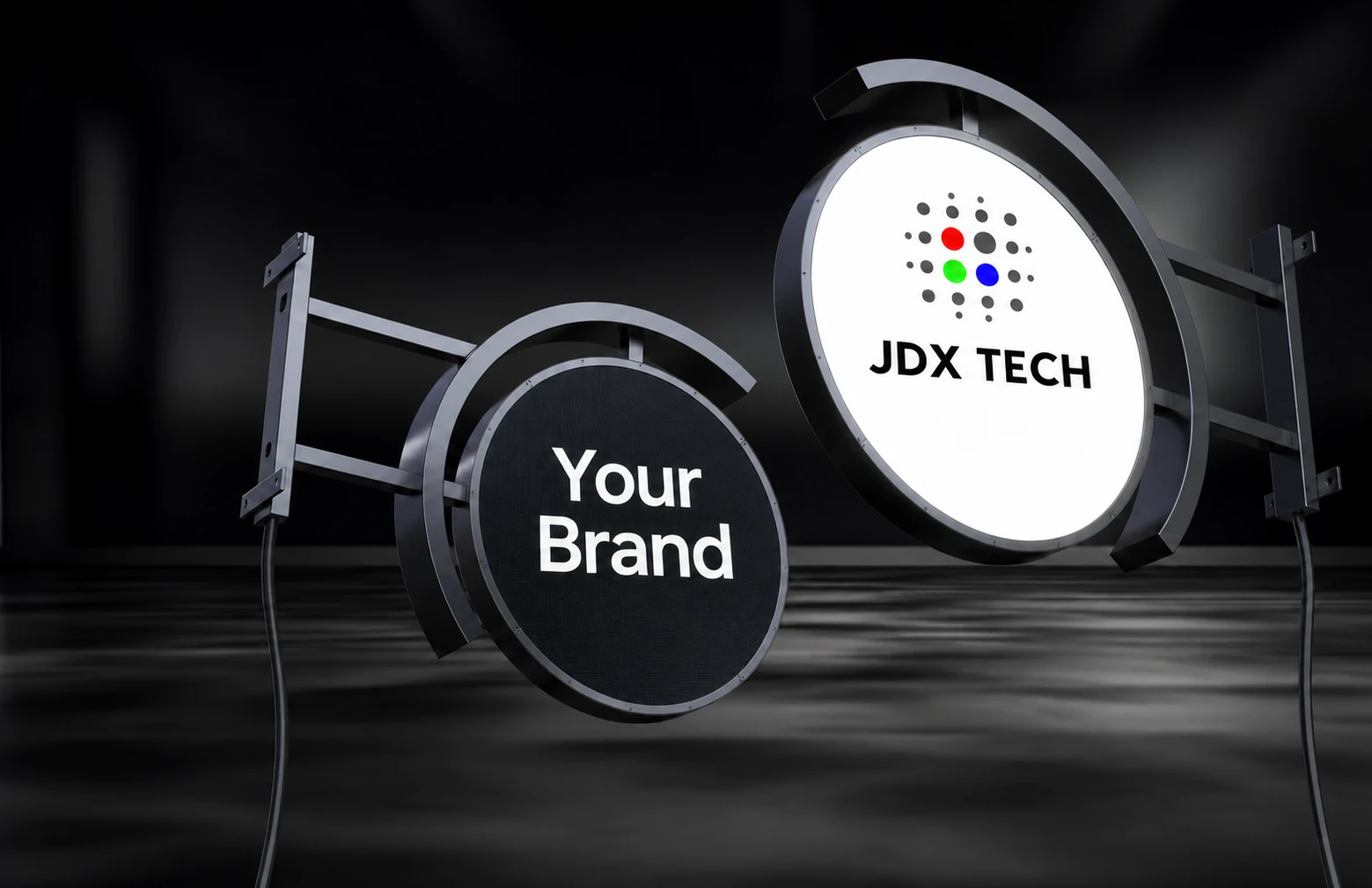
Circle 500, double-face. One 50 mm body, two 500 mm faces, cantilever bracket; the near face is lit, the far face is shown switched off.
15 seconds, one unit. Both faces run at once — each side carries its own LED module and driver, so the near face and the far face can hold different content.
A circular LED display with both faces running
The clip shows a 500 mm Circle 500 mounted on a freestanding pole, near face lit and playing full-colour video. The far face is not a mirror of it: each side has its own module and its own driver, which is the difference between a true double-sided circular LED display and two single units bolted back to back.
A round screen solves something a 16:9 panel cannot. Standing on a pole in the middle of a walkway, the disc reads as a sign from the front and still reads as a disc in profile — so it does not have to be turned to favour one direction of foot traffic. At 500 mm the face is sized for 3–10 m, roughly the width of a shop-lined street.
- 500 mm diameter, 256 × 256 px per face at P1.9
- 4,000 nits, IP65, −20 to +45 °C
- Content pushed by phone app or RJ45 cable — 4G module optional
- Pole collar and base cut to your tube diameter
Specifying a pole-mounted unit? Send the tube diameter and the mounting height with your enquiry. The collar and base are fabricated to suit, and that drawing is what the site team needs before anything ships — it is also the one item in the order that cannot be changed once production starts.
Where a circular LED display works best
Each application below fixes a different viewing distance, ambient light level and mounting substrate. The notes say what to confirm before you settle the pitch and the bracket.
Storefront and franchise signage
This is the application the 500 mm size was drawn for. Across a shopfront the disc is read at 3–10 m, so a logo needs roughly 200 px of clear height — inside the 256 px face that leaves room for one line of text. Brightness ≥4,000 nits holds a west-facing wall in direct afternoon sun; the app lets a franchisee swap the promotion without touching the network.
Business districts and shopping streets
A double-face unit serves both directions of foot traffic from one power drop, which is the whole reason to pay for the second face rather than hang two single units. The 160°/160° viewing angle keeps the mark legible from the far side of a walkway, and the 50 mm body sits flat against the fascia line.
Pedestrian and culture streets
Where the street furniture is already dark metal, the 49 mm mounting tube and 50 mm body disappear into the pole. The frame structure is the variable here — brackets, arm length and surround can be cut to match a street design code, including lattice or traditional frames.
Community, parks and scenic spots
Pole-mounted at 2.5–3.5 m, a round screen replaces a static park sign and can carry opening hours, wayfinding and event notices. IP65 and −20 to +45 °C cover most temperate and subtropical installations; the temperature-controlled ventilation matters more than the IP number on a unit this small, because the driver sits inside a sealed 50 mm body.
Traffic arteries and roadside poles
High mounting depends on brightness headroom, not resolution. At 15–30 m the face is a coloured disc: ≥4,000 nits and a 160° horizontal angle are what keep it readable from a moving vehicle, and the app's dimming schedule is what keeps it from becoming a nuisance at night.
Showrooms, exhibitions and brand corners
Indoor use at reduced brightness. The integrated 3 W speaker and phone control mean one unit can be re-purposed between stands without a media player, a laptop or a technician — which is usually the deciding factor for a rental or exhibition fleet.
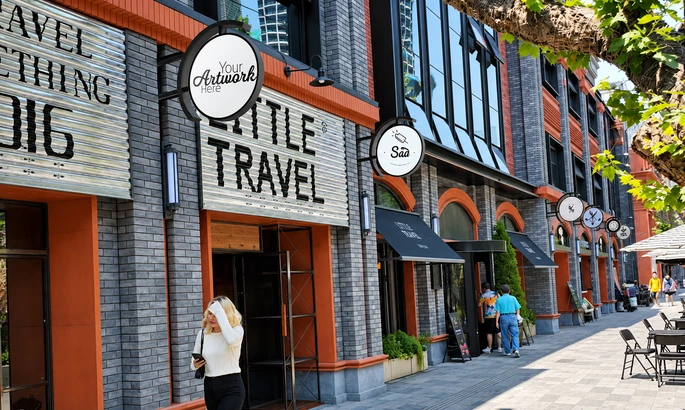
Pedestrian street, single-face units on shop brackets. The screen replaces a static blade sign without changing the shopfront line.
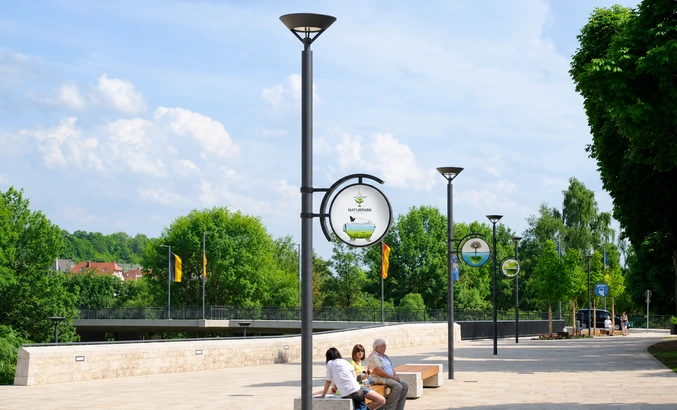
Community and scenic spot use: pole-mounted, 2.5–3.5 m, one unit per pole.
Not the right shape for your site? If the wall can take a rectangle, a conventional outdoor LED display gives you far more pixels per dollar. Round is for facades, poles and street furniture where the shape is the constraint — the same logic that puts a sphere display in an atrium instead of a flat wall.
P1.9 or P1.5 — which face fits your round LED display project
Both models share the same 500 mm shell, the same 50 mm body and the same bracket. The only difference is how much detail the face can carry at a given distance.
| Model | Pixel pitch | Resolution per face | Brightness | Best viewing distance | Typical use |
|---|---|---|---|---|---|
| Circle 500 P1.9 | 1.9 mm | 256 × 256 px | ≥4,000 nits | 4 m and further | Shopfront fascia, pole signage, roadside |
| Circle 500 P1.5 | 1.5 mm | 320 × 320 px | ≥3,500 nits | 3 m and further | Close-range logo detail, indoor brand corners |
A 500 mm circle holds 500 ÷ pitch pixels across its diameter, which is why P1.9 lands on 256 and P1.5 lands on 320. In practice the pitch decision is made by the smallest element in your artwork, not by the screen size: a single-line wordmark survives P1.9 at 4 m, while a logo with a thin rule or a two-line tagline needs P1.5 to stay clean at 3 m.
Single-face and double-face versions use the same shell and the same bracket. A single-face unit is 50 mm thick as well — the second face is added inside the body, not bolted on — so a site can start single and be upgraded later without changing the mounting.
Circle 500 full specifications
Reference values from the current production configuration. Confirm the exact model and its approved datasheet before the order is released — values are re-measured on the sample that ships to you.
| Parameter | Value |
|---|---|
| Model | Circle 500 — double-face P1.9 (single-face and P1.5 on request) |
| LED configuration | SMD1415 |
| Screen diameter | 500 mm per face |
| Resolution per face | 256 × 256 px (P1.9) · 320 × 320 px (P1.5) |
| Screen thickness | 50 mm |
| Overall size with bracket | 755.4 × 600.5 mm |
| Depth from wall | 100 mm |
| Wall plate | 224 × 77.8 mm |
| Mounting tube diameter | 49 mm |
| Brightness | ≥4,000 cd/m² (P1.9) · ≥3,500 cd/m² (P1.5) |
| Viewing angle | Horizontal ≥160° · Vertical ≥160° |
| Colour temperature | 5,000–11,000 K |
| Control method | Phone app · RJ45 · 4G optional |
| Audio | Integrated 3 W speaker |
| Input voltage | 100–240 VAC |
| Average power consumption | ≤100 W |
| Maximum power consumption | ≤200 W |
| Heat dissipation | Temperature-controlled automatic ventilation |
| IP rating | IP65 |
| Operating environment | −20 to +45 °C · 0–80% RH, non-condensing |
| Storage environment | −30 to +80 °C · 0–95% RH, non-condensing |
| Net weight | 7.5 kg |
| Gross weight | 10 kg |
| Packaging dimensions | 830 × 145 × 626 mm |
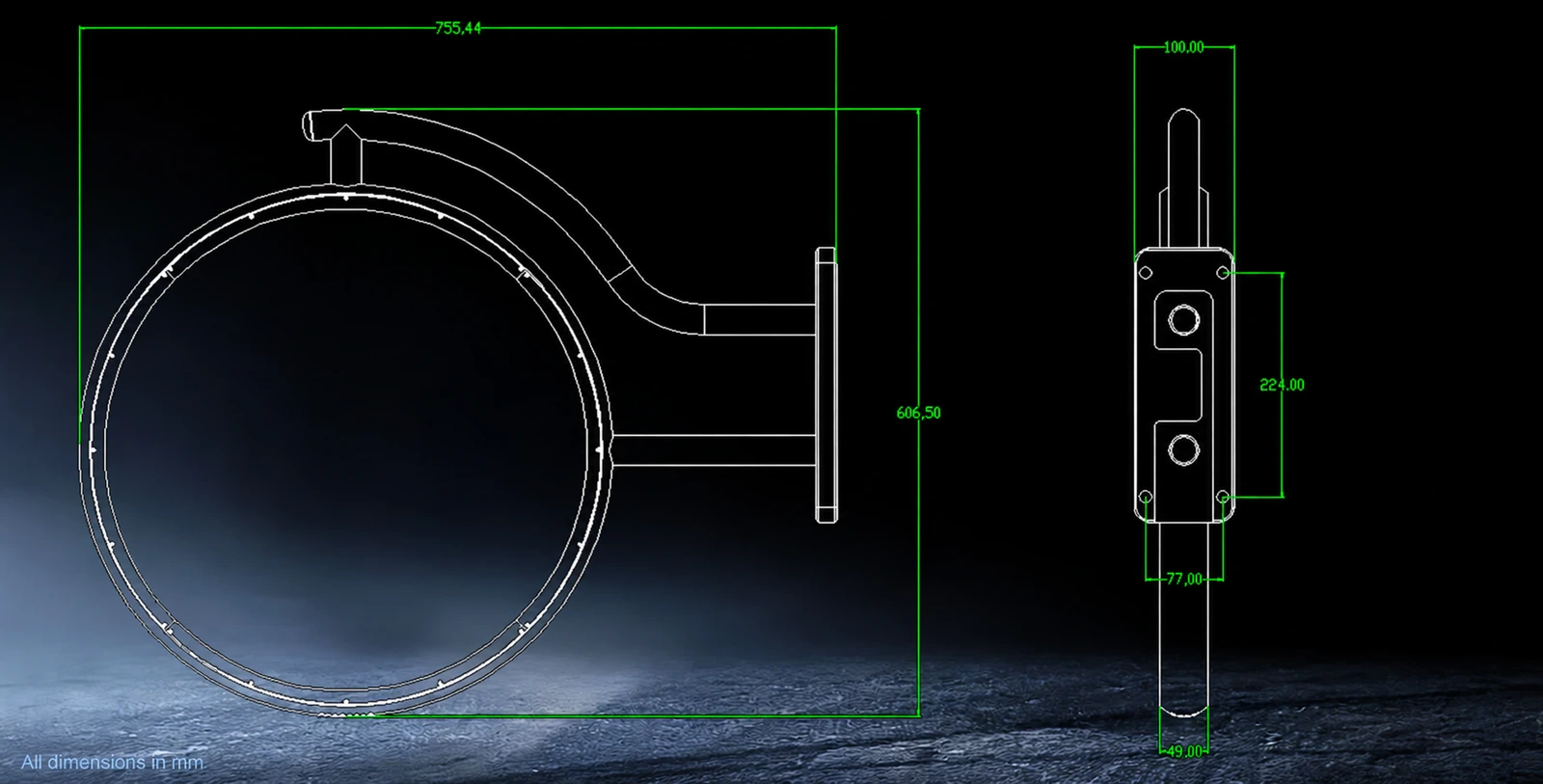
Front and side view, bracket included. Overall 755.4 × 600.5 mm, 100 mm off the wall, 224 × 77.8 mm wall plate.
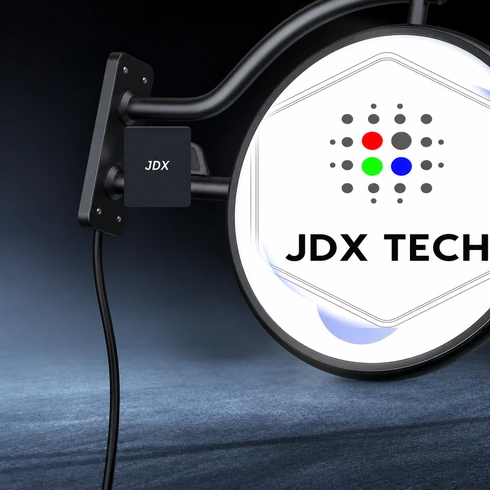
Cantilever bracket: two bolts into the wall plate, one cable through the arm. No additional cabinet on site.
Mounting, in one paragraph
The bracket is part of the product, not an accessory. The wall plate is 224 × 77.8 mm with two fixing points, the arm puts the face 100 mm off the wall, and the cable runs inside the arm so nothing is surface-clipped up a facade. Hanging versions use the same body on a pole collar around a 49 mm tube. Either way the screen arrives assembled — there is no cabinet to build on site.
What the datasheet does not cover
Wall substrate, wind loading and the electrical circuit belong to the site, not to the screen. A 10 kg gross unit on a 100 mm cantilever puts a pull-out load on the fixing, so the plate needs solid masonry, a steel member or a pole collar — plasterboard and thin cladding will not hold it. Confirm the fixing with whoever owns the wall before the order is placed; it is the single most common reason an installation stalls on arrival.
What this circular LED display costs
Quotations are built line by line, because two sites that ask for the same 500 mm disc rarely need the same bracket, the same face count or the same control route. What follows is the structure of the number rather than a headline figure that would not survive contact with your site.
What moves the price most
Pixel pitch is the first driver — P1.5 carries 56% more pixels than P1.9 on the same 500 mm face, and the module cost follows. Second is face count: a double-face unit is not two screens, but the second face still adds modules, a receiving card and calibration time. Third is the frame — a standard cantilever arm is a stock item, while a surround cut to a street design code is fabrication.
What the quote should itemise
Screen, bracket, control option (RJ45 as standard, 4G module as an add-on), spare modules, packaging, and freight separately. Ask for the packing dimensions (830 × 145 × 626 mm, 10 kg gross) so you can price the courier yourself if you prefer — on units this size, express freight is often a meaningful share of the total.
What is usually excluded
Installation, the electrical circuit and any local permits. Content design is also excluded: a circle needs 1:1 artwork with the mark inside the inner 70% of the frame, and if your agency has never built for a round canvas the first draft will lose its corners. Ask for the artwork template with the quote.
How to compare two quotes fairly
Four things must match or the comparison is meaningless: pitch and resolution, the method used to state brightness, the IP rating on the cable entry as well as the face, and the control route. A cheaper quote that lists 4,000 nits without saying whether that is a peak or a calibrated figure is not a cheaper quote.
To get a number in one exchange, send four things: diameter and quantity, single or double face, mounting height and substrate, and whether the site faces direct sun. With those we return a line-item quote and the lead time on the same reply — see the contact page.
From inquiry to delivery
Five stages, each with a deliverable you can check. The lead time below is the production clock, not the delivery date — freight sits on top of it.
1. Requirement review
24 hoursYou send diameter, quantity, face count, mounting height, substrate and sun exposure. We come back with the model that fits, or with the two questions that are still open.
2. Solution and quotation
2 working daysLine-item quote, datasheet for the exact model, bracket drawing and an artwork template with the safe circle marked. Nothing is confirmed until you approve the drawing.
3. Pre-production check
3–5 daysModules are matched for brightness and colour before assembly, and the bracket is checked against the site drawing. You get photographs of the matched modules before production starts.
4. Production and QC
15–25 working daysAssembly, 72-hour aging, calibration on both faces, then a full-brightness and full-white test recorded on video. The unit ships only after the faces match each other.
5. Shipping and support
25–35 days by seaPacking list, commercial invoice and certificate pack go out with the shipment. Sea freight is the default for volume, air and express for samples and single units.
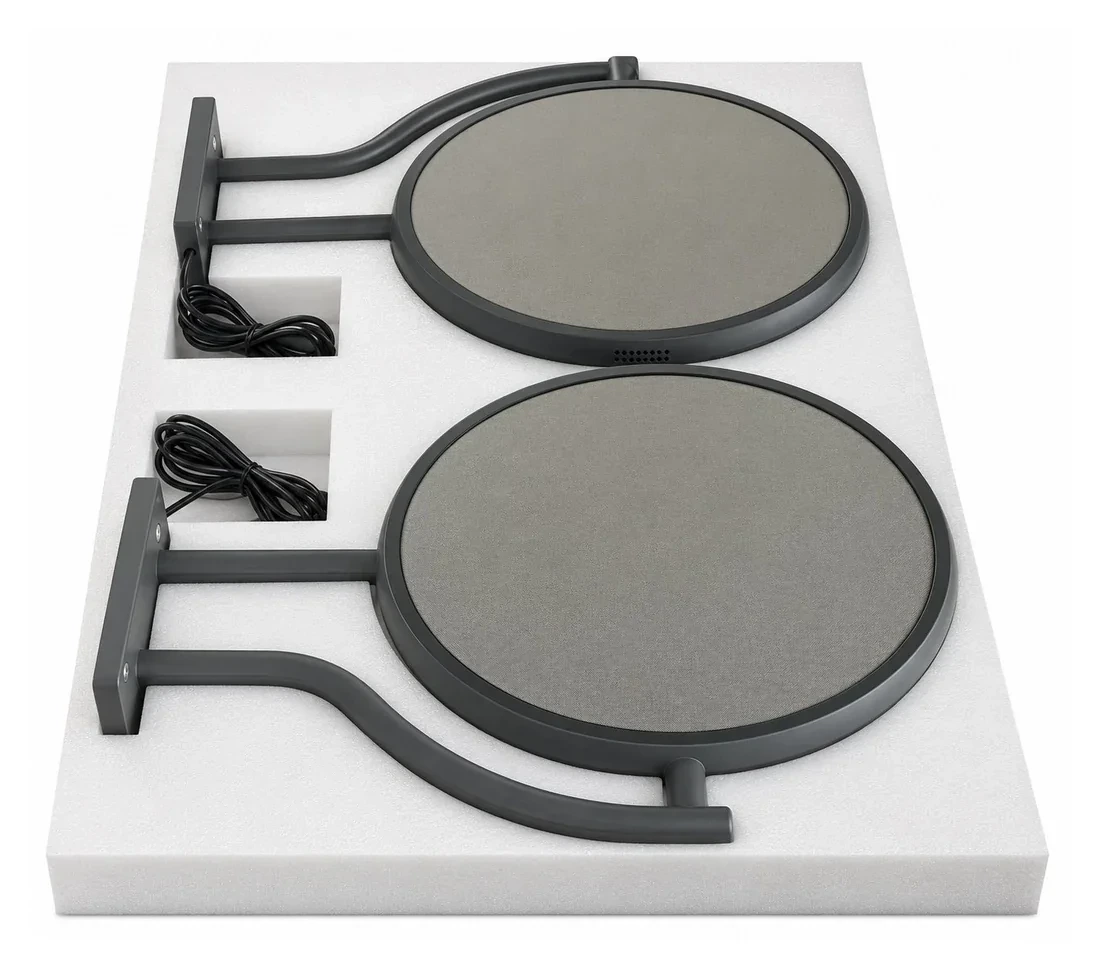
Packaging: one PE foam block, cut so each screen, its bracket arm and its coiled cable rest in their own recess.
How the unit is packed
Nothing in the carton touches cardboard. The screens, brackets and cables are laid into a single block of PE foam cut to the profile of the hardware — a round pocket for each 500 mm face, a channel for each bracket arm, a square recess for each coil of cable — so the LED surface carries no load and nothing shifts in transit.
The foam block then goes into a carton at 830 × 145 × 626 mm, 10 kg gross. That depth is the number worth noticing: at 145 mm the packed unit moves as a parcel rather than a pallet, which is what keeps single-unit air freight affordable and lets a sample ship without a forwarder.
The bracket travels in the same carton, so there is no separate hardware box to chase on site — the fitter opens one carton and has the screen, the arm and the wall plate in hand.
How to compress the lead time
Three things actually shorten the clock. Fix the artwork before production rather than during aging — a late artwork change means re-calibrating both faces. Approve the bracket drawing in week one, because a customised frame is the only item in the order that is fabricated rather than assembled. And book freight before the QC date: 830 × 145 × 626 mm at 10 kg gross per unit is a pallet-or-parcel decision, and leaving it until the goods are packed is what turns a 25-day build into a 45-day arrival.
What to understand before you buy
Four things decide whether a round screen looks like a brand asset or a novelty. None of them are on the specification sheet.
Pixel pitch on a round canvas
Resolution is set by the diameter, not by a cabinet grid: 500 ÷ 1.9 gives 256 pixels across, 500 ÷ 1.5 gives 320. Because the canvas is a circle, the usable area is about 78% of the square that encloses it — plan the mark for the inner 70% and the corners stop mattering.
Artwork is 1:1, not 16:9
Almost every signage asset you own is horizontal. A circular display needs a square canvas with the content centred, and any text set in the corners will be cut. Ask for the template at the quoting stage — it costs nothing then and a re-shoot later.
Brightness in nits is only half the story
4,000 nits is what keeps a face readable in direct sun; the other half is the dimming schedule. A unit that runs at full output after dark is the fastest way to lose a permit, which is why the app exposes a schedule rather than a single slider.
Two faces, one controller
The double-face version drives both faces from one controller, so content stays in sync and the site needs one cable. If the two faces are meant to show different content — one for pedestrians, one for traffic — say so before the order, because that is a different receiving-card configuration.
Power is worth a line of its own: 100–240 VAC input and ≤100 W average means a single unit can run from a standard lighting circuit, and a pole installation does not need a dedicated three-phase supply. Maximum draw is ≤200 W at full white, so ten units on one circuit still sit inside a 16 A breaker with headroom.
For how these figures are measured — and for the datasheet of every other family we build — see the LED display datasheets library.
Six mistakes buyers make when comparing circular LED displays
Each of these has cost one of our customers a re-order, a delay or a permit. They are listed in the order they usually surface.
1. Designing the artwork last
The screen is ordered, the hardware arrives, and someone discovers that the logo was built for a 16:9 slide. Re-cutting content for a circle after installation is the most expensive way to learn that a round canvas needs a square master.
2. Comparing brightness numbers without the method
A 4,000-nit peak reading and a 4,000-nit calibrated reading are different products. Ask whether the figure is measured after calibration, at what colour temperature, and on how many modules.
3. Ignoring what the bracket hangs from
A 10 kg unit on a 100 mm cantilever loads the fixing in pull-out, not in shear. Timber cladding, plasterboard and thin composite panels will not hold it, and the fix is a steel spreader — which nobody quotes at the start.
4. Reading IP65 as waterproof
IP65 covers the face and the body. The cable entry, the gland and any joint made on site are only as good as the installer; a unit that fails in year two usually failed at the gland in week one.
5. Buying single-face for a two-way street
If foot traffic passes on both sides, one face means half the audience sees a black disc. The upgrade path exists, but it is cheaper to decide at order time than to add a face later.
6. Forgetting the audio
The integrated 3 W speaker is a real feature and a real nuisance: three neighbouring units with independent audio schedules will not stay in sync. Plan one audio source per group, or run them muted.
Why projects specify JDX circular LED displays
Four things we can be held to, on any order.
Factory-direct, no reseller layer
The unit is assembled and calibrated in our own Shenzhen plant. There is no trading layer between the quote and the production line, which is why a specification question gets answered with a measurement rather than a datasheet link.
Both faces calibrated before packing
A double-face unit is only as good as the match between the two faces. We calibrate them against each other at full white and record the result, because a 200 K difference between faces is visible from across a street.
Documents that clear customs
Packing list, commercial invoice, certificate pack and the model datasheet ship with the goods. Consignments held for a missing document cost more in storage than the document costs to produce.
Support after delivery
Spare modules and receiving cards are quoted with the order rather than after the failure. Remote diagnosis over the app is usually enough to tell a module fault from a configuration fault before anyone ships a part.
JDX Tech has been building LED displays in Shenzhen since 2014, with projects in 100+ countries. The manufacturer profile covers the plant, the calibration process and the certificate list; the product range covers the rest of the families.
Questions buyers ask before ordering
Short answers with the numbers that decide the configuration. If your question is about a specific site, the contact form gets a faster answer than the list below.
What is a circular LED display used for?
It is used where the shape is fixed by the site: shopfront fascias, shop-lined streets, park and plaza poles, traffic islands and exhibition stands. The 500 mm face reads as a logo disc at 3–10 m, which covers most street-level signage briefs.
How much does a 500 mm circular LED display cost?
It is quoted per project rather than sold from a list, because the bracket and the face count change with the site. Send diameter, quantity, single or double face, mounting height and substrate, and whether the face catches direct sun — those five lines are enough for a line-item quote.
Single-sided or double-sided?
Double-face if people pass on both sides of the unit, which is the norm on a shop-lined street or a pedestrian route. Single-face if the back is against a wall, a window or a service area. The shell and the bracket are identical, so the choice is about audience, not installation.
Can it run video, or only a logo?
Both. 256 × 256 pixels is enough for a rotating logo, a two-line promotion or a short loop; it is not enough for detailed footage. Most customers run a static mark with two or three scheduled frames, which is also what keeps the unit inside local signage rules.
What artwork size should I supply?
A square master, 1024 × 1024 px or larger, with the mark inside the inner 70% of the canvas. We send the template with the quote — the safe circle is drawn on it, so your designer can see exactly what will be cut.
How is it powered and controlled?
100–240 VAC in, ≤100 W average and ≤200 W at full white, so a standard lighting circuit is enough. Control is by phone app over a single RJ45 cable; an optional 4G module removes the need to pull that cable up a pole.
What is the lead time?
15–25 working days for production, plus 25–35 days by sea or a few days by air or express. A customised frame adds fabrication time, so approve the bracket drawing in the first week if the schedule is tight.
Can the frame match our street furniture?
Yes. The bracket, arm length and surround are the parts we customise — a plain cantilever for a plain street, a lattice or traditional frame where the street design code calls for one. Send a photograph of the existing pole or fascia and we will draw to it.
Is a circular LED display the same as a round LED screen?
Yes — round LED screen, circle LED screen and circular LED display are three names for the same disc-shaped unit, such as this 500mm double sided model with one LED face on each side of the body. The search terms differ; the product does not.
Planning a circular LED display project?
Send the diameter, the quantity, the mounting height and a photograph of the site. You will get a model recommendation, a line-item quote and the bracket drawing on the same reply — usually within two working days.