
Nightclub LED Screens & Bar Video Walls
One venue. Three visual stages. A complete experience.
Plan an indoor nightclub LED screen solution around your DJ, your audience and your venue identity.
A suspended sphere draws the eye upward — the highest element of the nightclub LED screen. A curved LED DJ booth puts the performer at the center. A Matrix LED video wall gives the room a bold visual backdrop. Plan all three around your venue, audience and content workflow.
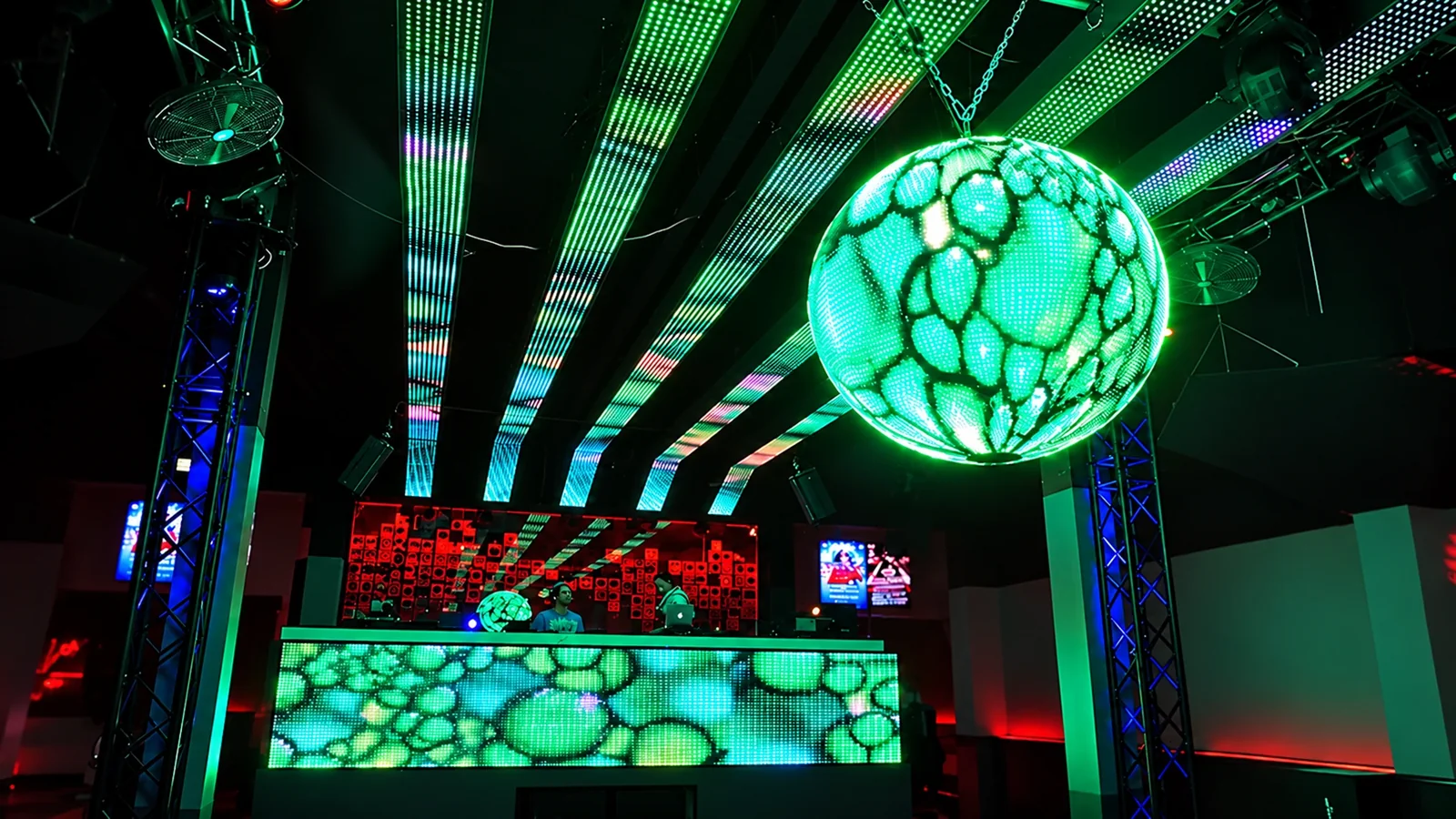
A nightclub LED wall. A DJ booth. An overhead focal point.
A nightclub LED screen is a video display for performance graphics, artist branding and venue content. It differs from decorative LED lighting and illuminated signs: the display uses pixels to show moving images.
For venue owners, interior designers and AV integrators planning a nightclub LED screen for a bar, lounge or indoor live entertainment venue, start with the space. Define what guests should notice from the entrance, what surrounds the performance and how the room changes through the night. The displays share a visual identity while each uses content designed for its shape and viewing position.
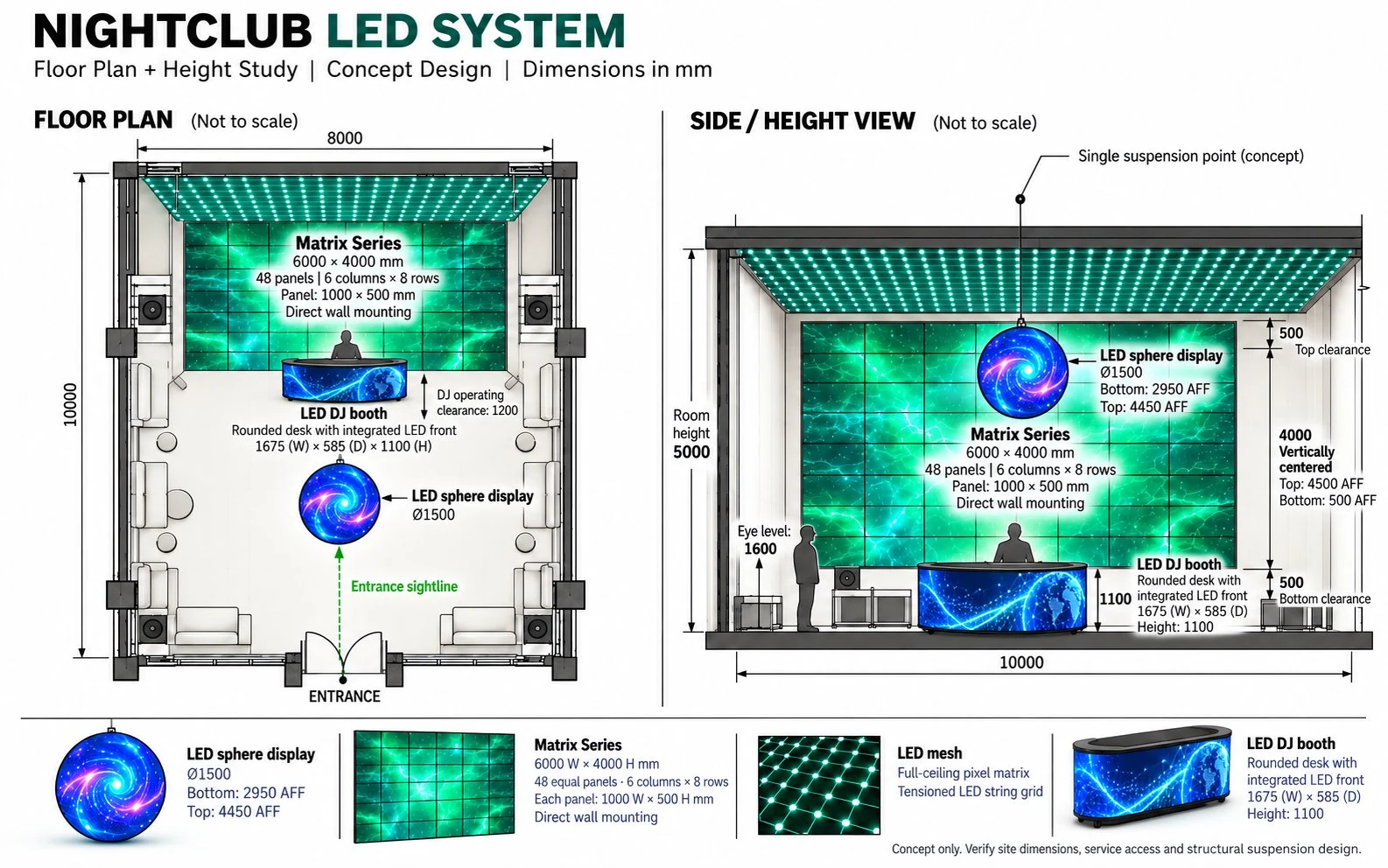
Above the crowd. At the decks. Across the background.
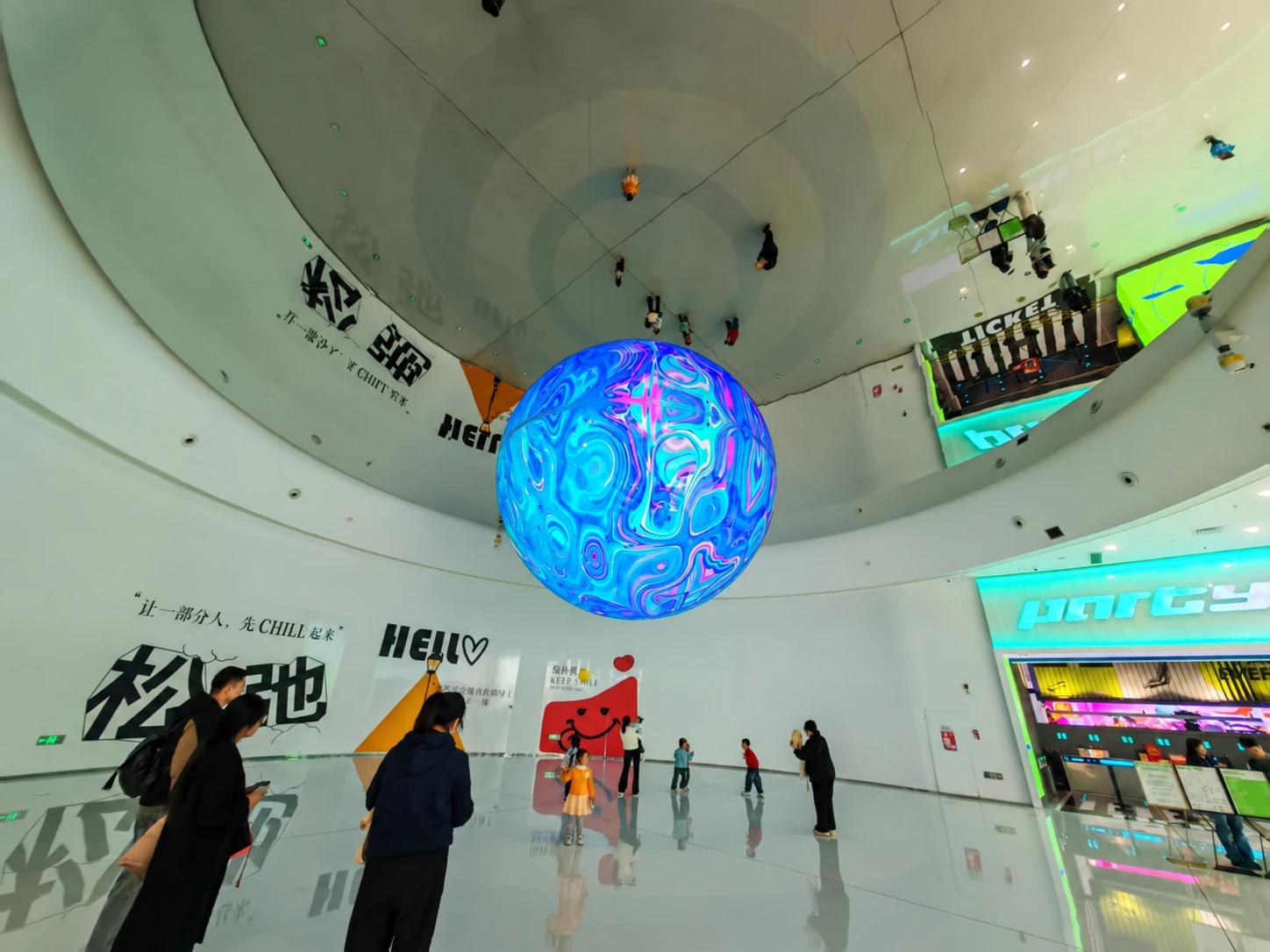
LED Sphere Screen
Turn unused overhead space into a distinctive visual accent — usually the first element of a nightclub LED screen that guests notice from the door. Use sphere-shaped graphics, brand motifs and slow ambient sequences to create an eye-catching centerpiece.
Explore 1m, 1.5m and 2m diameters, with P1.8 and P2.5 pitch options. Final model combinations and hanging suitability are confirmed for the project.
When the ceiling itself is the dominant surface, LED mesh pixel strips run alongside the sphere — the same content theme spread across the ceiling grid instead of concentrated in one object.
Explore LED Sphere Screens ↗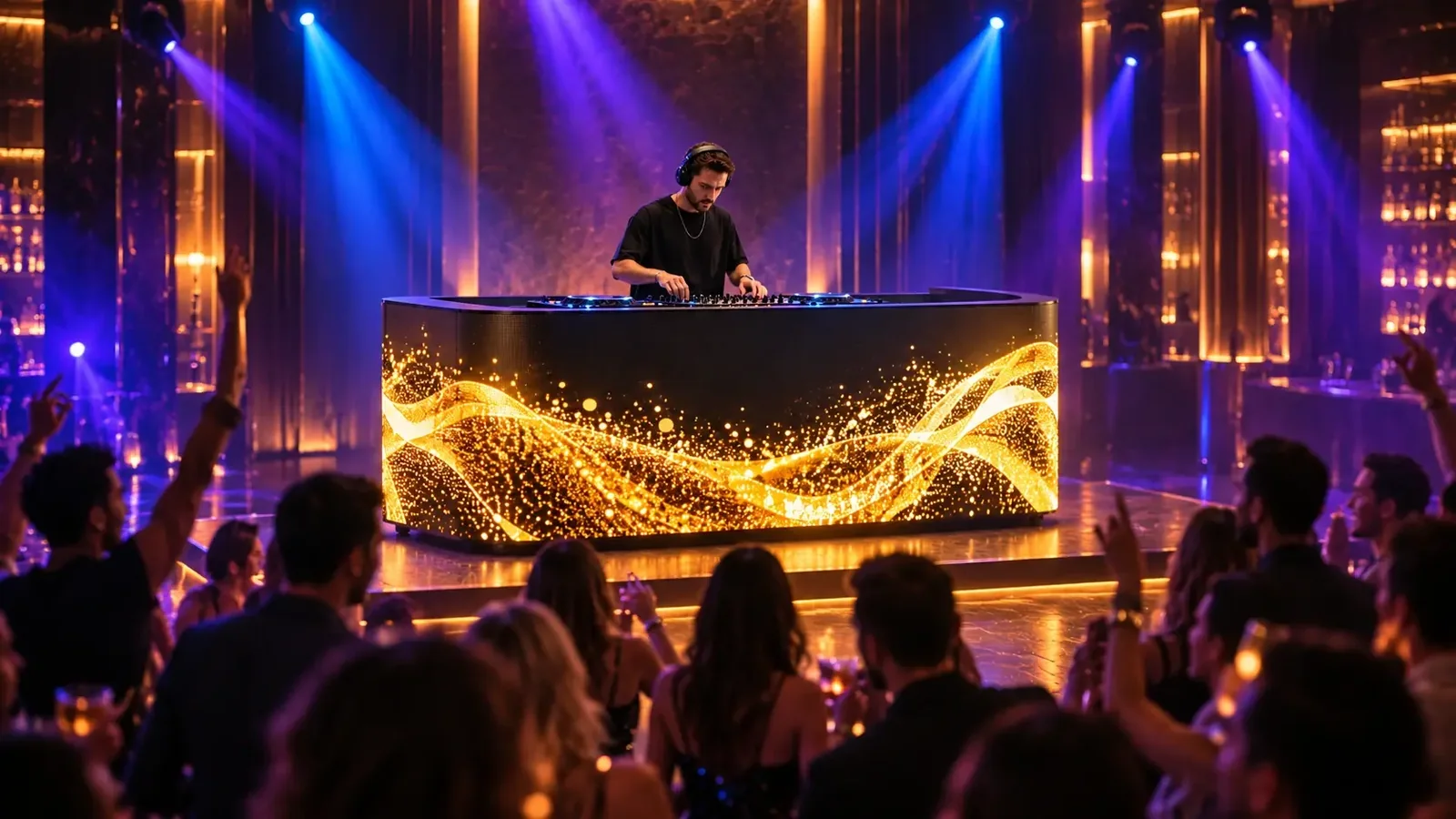
Curved LED DJ Booth
Make the audience-facing front of the DJ desk part of the performance — the part of a nightclub LED screen the crowd stands closest to. Show artist graphics, venue branding and video loops while keeping a usable working position behind it.
The nightclub LED screen desk comes in B and A models, offering P1.86 or P2.5 GOB panels, video playback and ≥3840Hz refresh. Wheels are optional; the desk is non-folding.
Compare LED DJ Booth Models ↗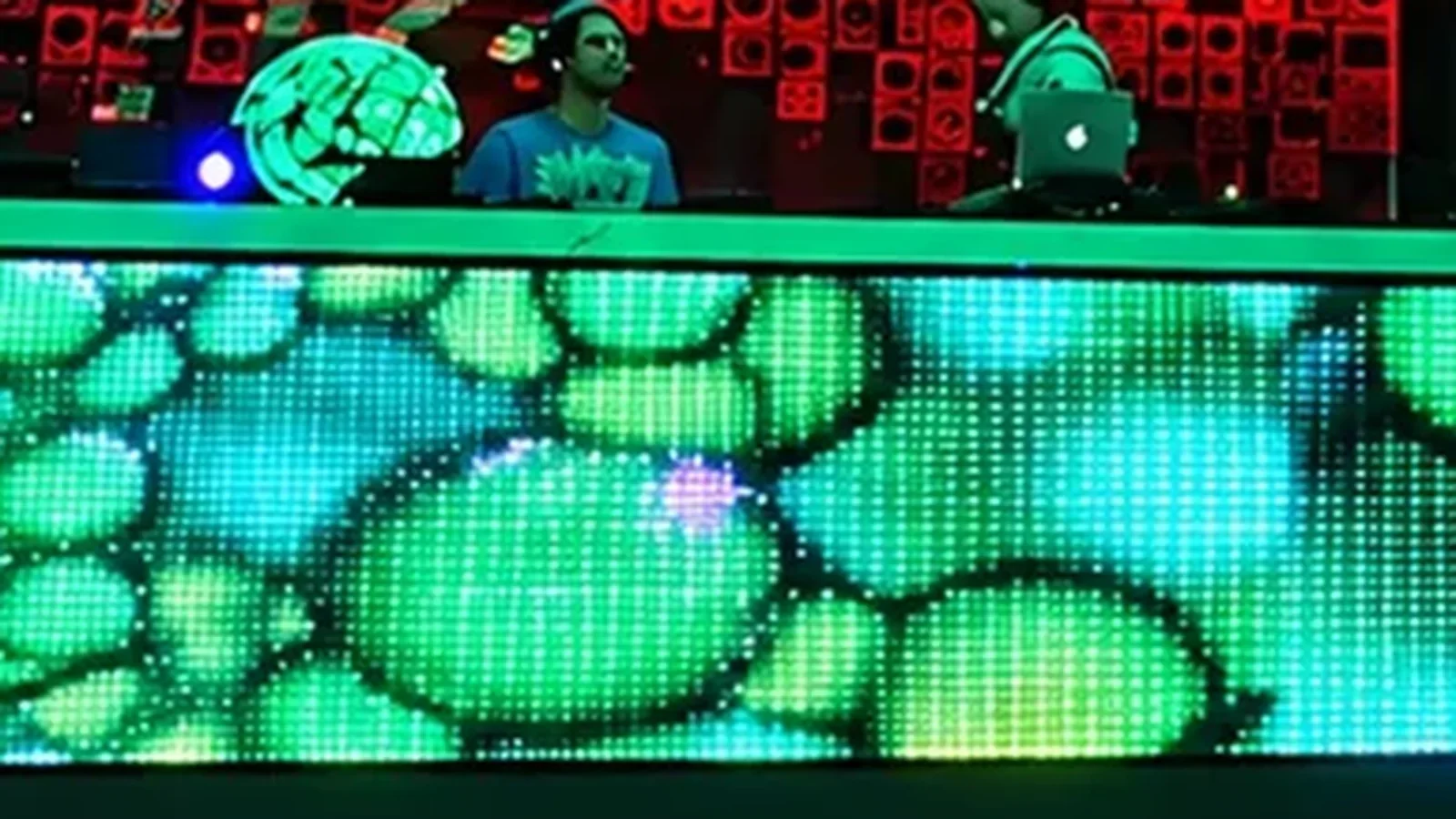
Matrix LED Video Wall
Build the main visual background behind the DJ or stage — the widest canvas of the nightclub LED screen. Use it for performance graphics, themed nights and branded content that guests can see across the room.
The Matrix indoor fixed series — the usual choice for the background of a nightclub LED screen — uses slim 33mm cabinets and front service. Select pitch, cabinet arrangement and wall size around the nearest audience position.
Explore the Matrix Series ↗Change the mood. Keep the scene connected.
Start with a shared color palette and a content plan for the nightclub LED screen. Then prepare separate layouts for the sphere, curved booth and flat wall, so the same visual theme works across three very different surfaces.
Opening & lounge hours
A nightclub LED screen at opening hours should use gentle motion and restrained brightness, keeping venue identity visible without overpowering the room.
DJ sets & themed nights
Place performer graphics on the booth, a larger visual sequence on the Matrix wall and complementary patterns on the sphere.
Brand takeovers & private events
Adapt the three canvases to event colors, logos and messaging, with text positioned where guests can read it.
Choose for close viewing. Set the brightness for the room.
Start with the nearest guest position, DJ workspace and actual wall dimensions. Compare the whole operating setup of the nightclub LED screen, not just the display area.
Design for guest sightlines
Pixel pitch is the spacing between LED pixels, and it is the first number to fix on any nightclub LED screen. Compare P1.86 and P2.5 on the DJ booth at the intended viewing distance; select Matrix pitch separately for the wall. Check small logos and text on a sample rather than applying one pitch to every display.
Test in the nightclub lighting
Discuss dimming range and low-brightness image quality: a nightclub LED screen spends most of the night far below its rated brightness. Balance the wall, booth and sphere so the performer remains visible. For filming, test the actual camera shutter, frame rate and content; the booth's ≥3840Hz refresh is a specification, not a guarantee against every camera artifact.
Keep the venue maintainable
Reserve Matrix front-service access and a practical maintenance route for the suspended sphere. Discuss ventilation, dust, haze-machine exposure and drinks near the booth. Confirm the required protection for each model; GOB alone does not establish a waterproof rating.
Choose the DJ desk footprint
A model: 1065 × 585 × 1100mm body.
B model: 1675 × 585 × 1100mm body.
Both offer P1.86 and P2.5. Select around decks, mixer, usable tabletop and operator space. Confirm the load rating; optional wheels do not change the non-folding construction.
View four DJ booth configurations ↗Plan your Matrix wall dimensions
Send the usable wall width and height, plus the nearest viewing distance. Cabinet layout determines the final display dimensions and resolution. A 33mm cabinet still needs its mounting support, cabling and ventilation allowance.
Review Matrix cabinet options ↗ Price the indoor wall you have ↗A complete setup needs more than three screens.
Agree the signal path, content ownership and installation scope for the whole nightclub LED screen before finalizing equipment. Coordinated visuals and frame-synchronized playback require different control arrangements.
Fit the venue
Before the nightclub LED screen layout is fixed, confirm the sphere's weight, suspension interfaces, structural load capacity and clearance. Check the desk footprint and equipment load. Reserve wall support, cooling and front-service access for Matrix.
Define the control workflow
Decide whether you need scheduled video loops or a live VJ workflow. A VJ is the operator who performs live visuals. Specify media sources, processors, output resolutions and content mapping for each display. The DJ booth's included AD20 is part of its own configuration; whole-venue control must be designed separately.
Plan handover
Agree power distribution, cable paths, brightness presets, spare parts and the operating guide for the nightclub LED screen. Identify who updates content, operates playback and handles maintenance.
Music-reactive effects, lighting integration and synchronized playback depend on the selected software, processors and interfaces. Confirm and test these functions within the agreed system scope.
One media source, one processor, four displays — each display with its own controller. The AD20 supplied with the DJ booth drives that desk only; it is not a whole-venue processor.
One solution concept. A layout built for your venue.
Screen size and pixel pitch on a nightclub LED screen follow the room, rather than a preset package. Pixel pitch is the distance between adjacent LED pixels; a smaller pitch can help at close viewing distances.
| Venue setting | Integrated layout direction | What to confirm first |
|---|---|---|
| Bar & lounge | An overhead focal point, a compact DJ desk position and a Matrix backdrop with restrained ambient content. | Ceiling height, seating sightlines, nearest viewing distance and available operating space. |
| Nightclub | A sphere above the approved performance zone, a prominent LED booth and a wider background canvas for themed visuals. | Rigging and wall support, crowd circulation, brightness, content workflow and service routes. |
| Indoor live entertainment | A coordinated visual stage for guest DJs, performers and branded events, with content prepared for each display. | Equipment footprint, camera requirements, playback interfaces and changeover procedure. |
Matrix is an indoor fixed display series. Frequent touring or temporary assembly needs a separate cabinet and installation review; see our stage and event LED solutions.
From room drawing to a tested visual experience.
Share the venue
Send a floor plan, ceiling and wall photos, approximate screen dimensions, audience distance, DJ equipment and your visual references.
Agree the complete scope
Confirm selected models, mounting drawings, control architecture, content formats, electrical needs and the responsibility for local installation.
Test before handover
Check content on every canvas, operator controls, brightness balance, service access and any agreed synchronization or music-reactive functions.
Know what is specified. Agree what the venue still needs.
The following is the current nightclub LED screen specification basis. Venue rigging drawings, the complete signal diagram and installation responsibilities must be confirmed in the project documentation.
| Display | Current specification basis | Project documents to confirm |
|---|---|---|
| LED sphere | 1m / 1.5m / 2m diameter options; P1.8 / P2.5, subject to model combination. | Selected-model weight and suspension interfaces; approved support and rigging drawing; clearance and maintenance route. |
| LED DJ booth | A: 1065 × 585 × 1100mm; B: 1675 × 585 × 1100mm. P1.86 / P2.5 GOB, ≥3840Hz; MRV412-N receiving card, AD20 control box, speaker system, AC 110–240V, 5m main cable and flight case. | Usable tabletop and equipment load, destination plug, optional wheels and access route. Packed: A case 1250 × 670 × 1300 mm at 160kg gross (94kg net); B case 1900 × 670 × 1300 mm at 215kg gross (127kg net). |
| Matrix backdrop | Indoor fixed display series; 33mm cabinet depth and front service. See the Matrix product specifications. | Wall dimensions, cabinet layout and resolution; support, ventilation, service space and selected controller. |
Rigging documentation
Identify who supplies the mounting design, verifies the venue structure and installs the suspension. Request selected-model drawings before approving overhead placement.
Control documentation
Agree a per-display signal diagram, content maps, source formats and operator workflow. Include an acceptance demonstration for any contracted synchronization or audio-reactive functions.
Delivery documentation
List screens, controllers, cables, mounting accessories, spares and agreed services. Assign shipping, local structural work, electrical installation, commissioning and training responsibilities in writing.
These specification and planning details are not an approved venue engineering design or a completed project case study.
Bar & nightclub LED solution questions.
Should I choose an LED wall, a projector or decorative LED lights?
An LED video wall provides a direct-view pixel canvas for moving images, which is why most nightclub LED screen projects start with this surface. A projector needs a suitable projection surface and a clear beam path. Decorative LED fixtures shape the lighting rather than replace a detailed video image. Compare them using your ambient light, viewing positions, content, installation space and operating requirements.
Can I start with the LED wall and add the booth or sphere later?
A nightclub LED screen installation can be planned in phases. Decide the final positions, power and cable routes first. Start with the display that serves the main performance area, then confirm processor capacity, content maps and installation interfaces for later additions.
Can an LED sphere screen be suspended above the venue?
A suspended sphere can be part of a nightclub LED screen layout. The chosen model's weight, suspension interfaces, ceiling structure, clearance and maintenance access must be reviewed, with an approved rigging design for the installation.
Can all three displays show the same visual theme?
Yes, the content plan across a nightclub LED screen installation can share common colors, graphics and branding. Prepare separate content maps for the sphere, curved booth and flat wall. Exact synchronized playback requires a compatible control architecture and project testing.
Will the displays automatically follow the music?
Audio-reactive visuals on a nightclub LED screen require suitable media software and signal integration. Define this requirement in the brief so its hardware, software and commissioning scope can be confirmed.
How do I choose the LED DJ booth size?
The B body measures 1675 × 585 × 1100mm; the A body measures 1065 × 585 × 1100mm. Both offer P1.86 or P2.5. Choose around your equipment layout, usable tabletop, load rating, operator clearance and access route.
Why use Matrix as the background wall?
Matrix is designed for indoor fixed LED installations, with slim cabinets and front service. Its cabinet arrangement and pitch can be selected for the available wall and audience distance. Mounting support and service space remain part of the venue design.
Does the solution include installation and content production?
The final quotation for a nightclub LED screen should list screens, control equipment, mounting accessories, spares and any agreed content or commissioning services separately. Confirm shipping, local structural work, electrical work and installation responsibilities before ordering.
Send the venue. Request a venue configuration.
Planning a new bar, a nightclub renovation, or an upgrade to a nightclub LED screen already in service?
Start with the room and the experience you want guests to remember. Request an integrated configuration covering the LED sphere, DJ booth and Matrix background wall, with a clear equipment and delivery scope.
Tell us about your project
- Venue type, location and target opening date
- Floor plan, ceiling height and wall dimensions
- Audience viewing distance and DJ equipment layout
- Sphere position, booth preference and backdrop size
- Scheduled loops or live VJ playback; synchronization and content needs
- Power, installation responsibilities and destination
On our contact form, choose Custom Solution and start your project details with Nightclub / Bar Integrated LED Solution. Include the sphere, DJ booth and Matrix requirements.