
P1.2 vs P1.5 vs P2.5 Which LED Pixel Pitch Do You Need?
Pixel pitch decides both how good your LED wall looks and how much it costs. Pick wrong one way and you pay for resolution nobody sees -- pick wrong the other way and your wall looks pixelated from three feet away. This guide settles it with real factory numbers — and shows why the P1.5 LED display is the volume leader for control rooms and meeting spaces.
In this guide
JDX TECH is a Shenzhen-based LED display factory (est. 2014) manufacturing fine pitch, indoor, outdoor and transparent LED screens for B2B export across Europe and North America.
Match pitch to your closest viewing distance
Roughly 1:1 in feet-to-millimeters. If you remember nothing else from this article, remember that ratio -- price, brightness, cabinet size and spares policy all follow from it.
Boardroom walls, broadcast studios, close-viewer dashboards.
Control rooms, meeting rooms, showroom feature walls.
Lobbies, larger control rooms, church and venue walls.
Fine pitch is wasted money at these distances.
Every supplier who quotes you without asking for the closest viewing distance is guessing at your money.
P1.2 vs P1.5 vs P2.5 at a glance
| Spec | P1.2 | P1.5 | P2.5 |
|---|---|---|---|
| Min. comfortable viewing distance | ~4-5 ft (1.2-1.5 m) | ~5-8 ft (1.5-2.4 m) | ~8-13 ft (2.4-4 m) |
| Pixels per m² | ~694,000 | ~444,000 | ~160,000 |
| Factory-direct panel price (per m², 2026)* | $1,400-2,000 | $950-1,400 | $650-1,000 |
| Typical use | Boardroom walls, broadcast studios, command positions | Control rooms, meeting rooms, showroom feature walls | Lobbies, larger control rooms, church / venue walls |
| Cabinet service | Front | Front | Front or rear |
| 16 m² wall, panel cost | $22,400-32,000 | $15,200-22,400 | $10,400-16,000 |
* JDX TECH 2026 export quotation ranges (FOB Shenzhen), indoor fine pitch lines, front service. Exact price depends on LED lamp brand, driver IC grade and order quantity.
Cost roughly doubles from P2.5 to P1.2
For the same wall area, panel cost steps up steeply -- the price curve is exponential, not linear.
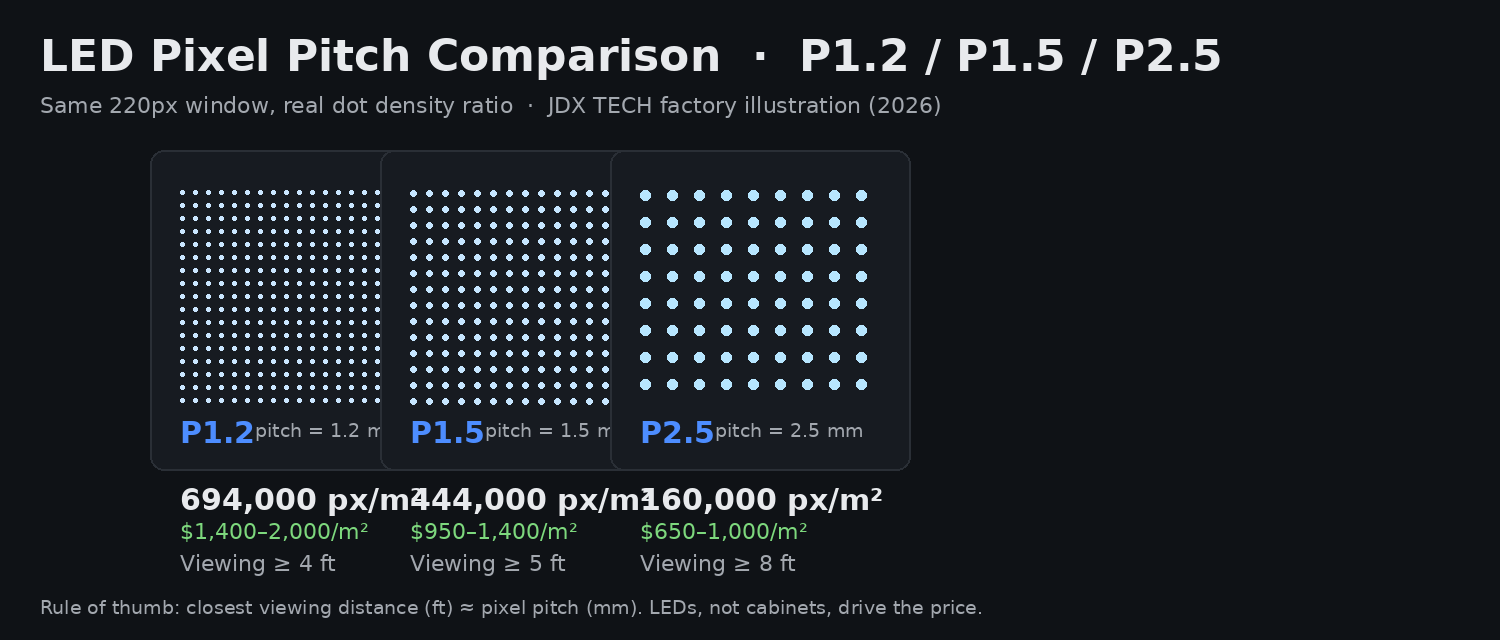
A P1.2 wall packs 4.3× the LEDs of P2.5
LEDs -- not cabinets -- are where the money goes. That's the entire reason for the price jump.
What pixel pitch actually means
Pitch is the center-to-center distance between two adjacent LEDs, in millimeters (technical definition). P1.5 means 1.5 mm.
Half the pitch = a quarter of the area per pixel = four times the LEDs per square meter. That's why the price curve is steep, not linear.
Stand far enough back and a P2.5 wall and a P1.5 wall show the same 4K video indistinguishably. Stand close and P2.5 shows the "screen door" effect. That threshold differs for text-heavy content versus video -- which is why the decision rule matters.
Distance + content type
Measure your closest viewer
Not the average seat, not the far wall -- the closest person who will actually read the screen. In a control room that's the operator at the front console.
Adjust for content type
Video hides pixel structure and lets you relax one tier. Dense text, dashboards and maps do not. See the table below.
Sanity-check pixel count
A wall is native "4K" when width ÷ pitch ≥ 3,840. If you want pixel-perfect 4K mapping, this single calculation ends the debate.
| Your content | Adjust the rule |
|---|---|
| Mostly full-motion video (lobby, stage backdrop) | You can relax one tier -- video hides pixel structure well |
| Dense text, dashboards, maps (control rooms, NOC) | Do NOT relax -- text exposes pixel structure first |
| Mixed (typical meeting room) | Follow the rule as written |
| 4K source at 1:1 pixel mapping | Follow the rule as written |
| Mostly up-scaled HD content | One tier relaxation is usually invisible |
90 seconds, one real room
A real configuration from a 2026 inquiry -- so you can see the method end to end.
Utility operations room, 26 ft deep. Wall 5.3 × 3 m on the short wall. Operator console 7 ft from wall; visitor bench 20 ft back.
7 ft → distance rule says P1.5 (5-8 ft band).
60% SCADA dashboards and maps, 40% video tiles. Dense text → do not relax. P1.5 confirmed.
5,300 mm ÷ 1.5 = 3,533 px wide -- slightly under native 4K. Acceptable. Going P1.2 purely for the last 300 px would add ~45% to panel cost for detail the source mostly does not have.
Total elapsed decision time: two emails and one measurement. That's the same worksheet our sales engineers fill in before every fine pitch quote -- which is why our first-number quotes rarely move after the site survey.
Where a P1.5 LED display fits best
From our 2026 order book -- the three configurations below cover the majority of fine pitch projects.
Control room, 6-9 ft viewing, 24/7
Operators read 12-pt-equivalent text comfortably. P2.5 forces font-size compromises on dense dashboards.
Control Room SolutionsExecutive boardroom, 4-12 ft, mixed content
P1.2 for the first row of seats to be comfortable -- or P1.5 if the room budget is fixed, accepting slight pixel structure up close on fine text.
Lobby or experience wall, 10+ ft, brand video
Every dollar saved here goes further into the processor or content, which guests actually notice.
One honest note from our quotation history: about a third of P1.2 inquiries we receive end up as P1.5 orders after we ask for the floor plan. The pitch decision is a distance decision, and distance is measured, not guessed.
A 16 m² wall across all three
Same wall, 5.3 × 3 m, front service, 3840 Hz refresh, camera-rated driver ICs -- panels only, FOB Shenzhen, JDX 2026 ranges.
| Configuration | Panel cost | + Processor & cards | Total hardware |
|---|---|---|---|
| P2.5 | $10,400-16,000 | $1,000-2,500 | $11,400-18,500 |
| P1.5 | $15,200-22,400 | $1,200-2,800 | $16,400-25,200 |
| P1.2 | $22,400-32,000 | $1,500-3,200 | $23,900-35,200 |
Cost step between the entry and mid tiers.
Same jump again to reach the finest tier.
Red flag: If a vendor quotes near-equal prices for P1.2 and P2.5, one of the two quotes is not what it claims to be. Lamp grade and driver ICs are where fine pitch vendors quietly cut costs.
Brightness, HDR and refresh move with pitch
Brightness
Indoor fine pitch targets 600-1,200 nits regardless of pitch. If a vendor quotes P1.2 at 2,000+ nits "for free," they're selling you outdoor LED lamps -- brighter, but usually worse color calibration and shorter lifespan at close viewing distances.
HDR capability
Concentrates at the fine end. Smaller pitch allows more local dimming zones and higher contrast. For cinematic content (lobbies, showrooms), P1.2-P1.5 with HDR delivers visibly better dynamic range than P2.5.
Refresh rate
A line-item, not a pitch feature. 3840 Hz camera-rated refresh costs about the same at any pitch -- don't accept "the fine pitch version has better refresh" as a bundled justification. Price it separately.
Structure and installation differences are minor at these pitches. Cabinet sizes and mounting systems are shared across our indoor fine pitch lines; a 16 m² wall weighs within 10% whether P1.2 or P2.5. Where installation does differ: finer pitch walls demand cleaner power (isolated circuits recommended) and dust-controlled rooms, because at 694,000 LEDs per m², panel-level failures are statistically more likely.
Installation, spares & ownership
Two fine pitch costs show up after the invoice -- and both scale with LED density.
Spares policy
At P1.2, individual LED failures are more numerous but each is less visible. Our standard is 2% module spares on first orders across all three pitches, with production records kept so replacements calibrate to the original wall. Budget spares as a purchase, not a "maybe."
Power and thermal planning
A 16 m² P1.2 wall at full white draws meaningfully more than its P2.5 counterpart. Plan circuits at 20% headroom over the spec sheet maximum and ventilate the cabinet plenum. Front-service magnetic modules make the eventual swaps a two-person, one-hour job instead of a scaffolding day.
Whatever the panel quote says, all-in cost lands 1.3-1.6× after processor, structure, freight and installation.
Common buying mistakes
-
01
Buying pitch for the farthest viewer
Pitch is decided by the closest viewer. The far wall always looks great -- it's the near seat that exposes the problem.
-
02
Chasing "smallest available pitch"
A P0.9 wall viewed from 10 feet is indistinguishable from P1.5 at a fraction of the price. This is the most common over-spec we see.
-
03
Ignoring cabinet size and seams
At P1.2-P1.5, a 0.05 mm seam variation is visible. Ask for the flatness tolerance and calibration report, not just the pitch number.
-
04
Forgetting the processor
A fine pitch wall fed by a cheap processor wastes its resolution. Budget the processor as 8-12% of panel cost.
-
05
Skipping the 4K mapping check
If your content is 4K, compute width ÷ pitch and make sure you're at (or near) 3,840 px. Otherwise you're scaling -- and paying fine pitch prices for scaled softness.
What about LCD video walls at these sizes?
Where video walls still make sense
- → Brightly lit rooms on a tight budget
- → Content that's mostly full-screen video
- → Viewing distances of 15+ feet
- → 30-50% lower upfront cost than P1.8-P2.5 LED
Where LCD loses in fine pitch conditions
- → Bezels every panel edge break up dashboards and maps
- → Brightness and color drift between panels over 2-3 years
- → Viewing angles fall apart off-axis
- → If you're comparing P1.2/P1.5 against LCD, you're in close-viewing use -- and that's LED territory
P1.2 vs P1.5 vs P2.5 questions
Is P1.5 good enough for a control room?
How much more does P1.2 cost than P2.5?
What viewing distance is P2.5 LED?
Which pixel pitch is best for a 4K video wall?
Can I mix P1.5 and P2.5 in one installation?
Does pixel pitch affect viewing angle?
Does smaller pixel pitch use more power?
Send us your floor plan -- get a quote, not a brochure
JDX TECH builds fine pitch LED displays from P0.78 to P1.875 with HDR, 3840 Hz refresh and front maintenance. Send the dimensions -- we answer with a number.