
Church LED Screen & Worship Display Manufacturer
Church LED Screen for Sanctuaries, Auditoriums and Multi-Site Campuses
JDX TECH builds church LED screens for the room you actually have — not for a showroom demo. Sanctuaries with a balcony, 60-year-old masonry walls, a volunteer running the booth on Sunday morning, and a livestream camera that turns every over-bright panel into a white rectangle. Those four constraints decide the specification, and this page works through them one at a time.
We are a Shenzhen LED display factory, exporting direct since 2014. No integrator markup, no rebranded panels: you buy the cabinet, the processor and the spares from the people who assemble them, and we quote the wall size you ask for.
Per square foot, factory-direct, for indoor P2.5 panels in 2026 — before processor and installation.
Of room depth is the screen height most sanctuaries settle on. A 70 ft room points to a 6–7 ft tall wall.
Nits. Going higher is the single most common specification mistake for rooms that livestream.
Why a church LED screen is specified differently
A retail wall is judged in the first five seconds by a person walking past it. A worship display is judged over ninety minutes, from the back row, by the same 400 people every week, while a camera records it. That change of context moves almost every number on the datasheet.
Sightlines from the balcony
The worst seat in the room is not the back row — it is the balcony overhang, where the viewing angle to the top of the screen is the shallowest. A wall sized to look right from the floor can be cut off at the top for a third of the congregation.
The camera is a second audience
Livestream viewers see the screen through a sensor with far less dynamic range than the human eye. Panels that look correct in the room routinely clip to pure white on stream — and that is a brightness decision, not a panel-quality one.
Volunteer operators
Your media team changes every few months. Anything that needs a trained technician to bring back online after a power cut will eventually sit dark on a Sunday. Presets, labelled inputs and a documented boot sequence matter more than an extra input card.
Ninety minutes, not five seconds
Sustained viewing changes what counts as comfortable. High brightness and aggressive contrast that impress in a demo become fatiguing across a full service, and they wash out the room lighting the worship team spent months tuning.
Three configurations that cover most worship screen projects
Nearly every sanctuary enquiry we receive maps to one of these three. They differ in pitch, in mounting, and in what happens when they fail — so they should be budgeted separately rather than lumped into one line item.
| Configuration | What it is for | Typical size | Pitch | Where it usually goes wrong |
|---|---|---|---|---|
| Main sanctuary wall | Lyrics, sermon media, scripture and stage backdrop behind the platform | 13–23 ft wide (4–7 m) | P2.5–P3 | Sized to the stage rather than to the room, so the balcony loses the top third |
| Stage-side IMAG screens | Camera feed of the speaker, close-ups for the back rows, confidence display | 8–13 ft wide (2.4–4 m), often paired | P3–P4 | Refresh rate too low, so the camera feed shows scan bands on livestream |
| Lobby and wayfinding | Service times, giving, announcements, overflow room relay | 4–8 ft wide (1.2–2.4 m) | P2.5–P3 | Left off the maintenance plan, so nobody notices a dead module for months |
A church LED screen rollout across a multi-site campus usually starts with the main sanctuary wall, adds IMAG screens at the second location, and retrofits lobby screens last. If you are planning a rollout rather than a single room, send the room dimensions for every site at once — cabinet sizes and processor models should carry across campuses so one spare kit covers all of them. The Matrix indoor fixed LED display is the cabinet family most church walls end up on, because it offers magnetic front service at these sizes.
Choosing pixel pitch for a church LED screen by viewing distance
The industry rule of thumb is one millimetre of pitch per metre of viewing distance. That rule was written for advertising screens read from across a concourse. In a sanctuary, where the content is lyrics and faces, add a margin — and then check the number against your balcony, not your floor.
| Nearest viewer to screen | Furthest viewer | Recommended pitch | Panel cost per sq ft |
|---|---|---|---|
| Under 6 m / 20 ft | 15 m / 50 ft | P2.5 | $60–95 |
| 6–9 m / 20–30 ft | 20 m / 65 ft | P3 | $55–85 |
| 9–14 m / 30–45 ft | 30 m / 100 ft | P4 | $45–70 |
| Over 14 m / 45 ft | 40 m+ / 130 ft+ | P5–P6 | $38–58 |
Do not buy one pitch finer than you need. Going from P3 to P2.5 on a 16 m² wall adds roughly $3,000–5,000 and changes nothing for a congregation sitting 12 m away. Put that money into the processor, the spare modules, or a second lobby screen instead. The exception is a room where the front row is within 6 m of the wall and the content includes small text — there, pitch is the whole point.
For the camera-specific trade-offs between pitch, refresh and moiré, the church LED video wall buying guide works through the seven decisions in sequence, including what to verify on a factory visit before signing.
Lyrics, scripture and the content nobody specifies
Screen specifications get argued over for weeks; the thing that actually decides whether the congregation can follow a song gets decided in ten minutes by whoever builds the slides. These are the content rules that matter on a worship wall, and they cost nothing to apply.
Four lines, not eight
A 16:9 wall that comfortably holds eight lines of lyric from the front row will lose the top and bottom four for anyone past the twentieth row, because the vertical viewing angle compresses. Build slides to four lines and the whole room stays on the same verse. This is the single highest-return change most churches can make, and it requires no hardware at all.
Text height of one screen-twelfth
As a working minimum, cap height should be at least 1/12 of screen height for the furthest viewer. On a 2 m tall wall that is a 16 cm capital letter — roughly 90–110 pt depending on the typeface. Thin weights and condensed fonts fall apart below that; a medium-weight sans holds up far better at distance than a stylish display face.
Never pure white on pure black
Pure #FFFFFF text on #000000 is the most fatiguing combination on an LED wall in a dark room, and it blooms on camera. Set text to around 85–90% white and the background to a deep tone rather than black; contrast stays high but the halation disappears. If you livestream, check the result on the actual stream feed, not on the monitor in the booth.
Respect the safe area
Keep all text inside a 5% margin from each edge. Cabinets are occasionally replaced, processors occasionally crop, and a lyric that runs to the very edge of the canvas will eventually lose its first letter. The LED display hardware will do exactly what it is told; the safe area is what stops a content mistake from becoming a Sunday morning problem.
Build four presets before the screen arrives
Almost every church runs the same four content states every week: full worship (lyrics, house lights down), sermon (speaker IMAG plus a lower-third, lights up), announcement loop (before and after service), and dark (screen off, room lit for prayer). Program each as a preset on the processor with its own brightness level, and label the buttons. A volunteer then presses one button instead of adjusting six settings, and the wall looks intentional at every point in the service rather than slightly wrong for most of it.
This is also the cheapest specification upgrade available: a processor with stored presets costs a few hundred dollars more than a basic scaler, and it removes the most common cause of a screen looking bad in a room where the hardware is perfectly fine.
Brightness and camera performance in a worship environment
Most Chinese factory quotes for a worship wall default to 5,000–6,000 nits because that is the standard outdoor panel specification. In a 300-seat sanctuary lit at 200–400 lux, that panel is running at 10–15% of capacity all service, which is exactly where LED drivers are least linear — you get banding in the dark areas of a lyric background and a blown-out white rectangle on camera.
Ask for a church LED screen rated 800–1,500 nits with low-brightness high-grey-scale instead. The panel then operates in its linear range, dims cleanly to match house lighting, and holds shadow detail when the camera iris opens up for the speaker.
Indoor sanctuary target. Dim to 15–20% for a dark room without losing greyscale.
Refresh rate floor for livestream. Below this, cameras catch scan bands on IMAG feeds.
Neutral white that matches stage lighting. Warmer panels fight the room; cooler ones look clinical.
Grey-scale processing depth. The number that decides whether dimmed content looks smooth or stepped.
The test that settles it
Ask the factory for a video of the panel at 20% brightness with a dark gradient on screen, filmed on the same camera model your church uses. Most suppliers will send a 100% white test pattern instead, because that is the only footage they have. A supplier who can produce the dim footage is a supplier who understands the room you are building.
Fitting a church LED screen into an existing building
New-build churches plan the screen with the structure. Everyone else retrofits into a wall that was designed to hold a painted backdrop. Four things decide whether a church LED screen install is straightforward or a six-week project.
Weight and structure
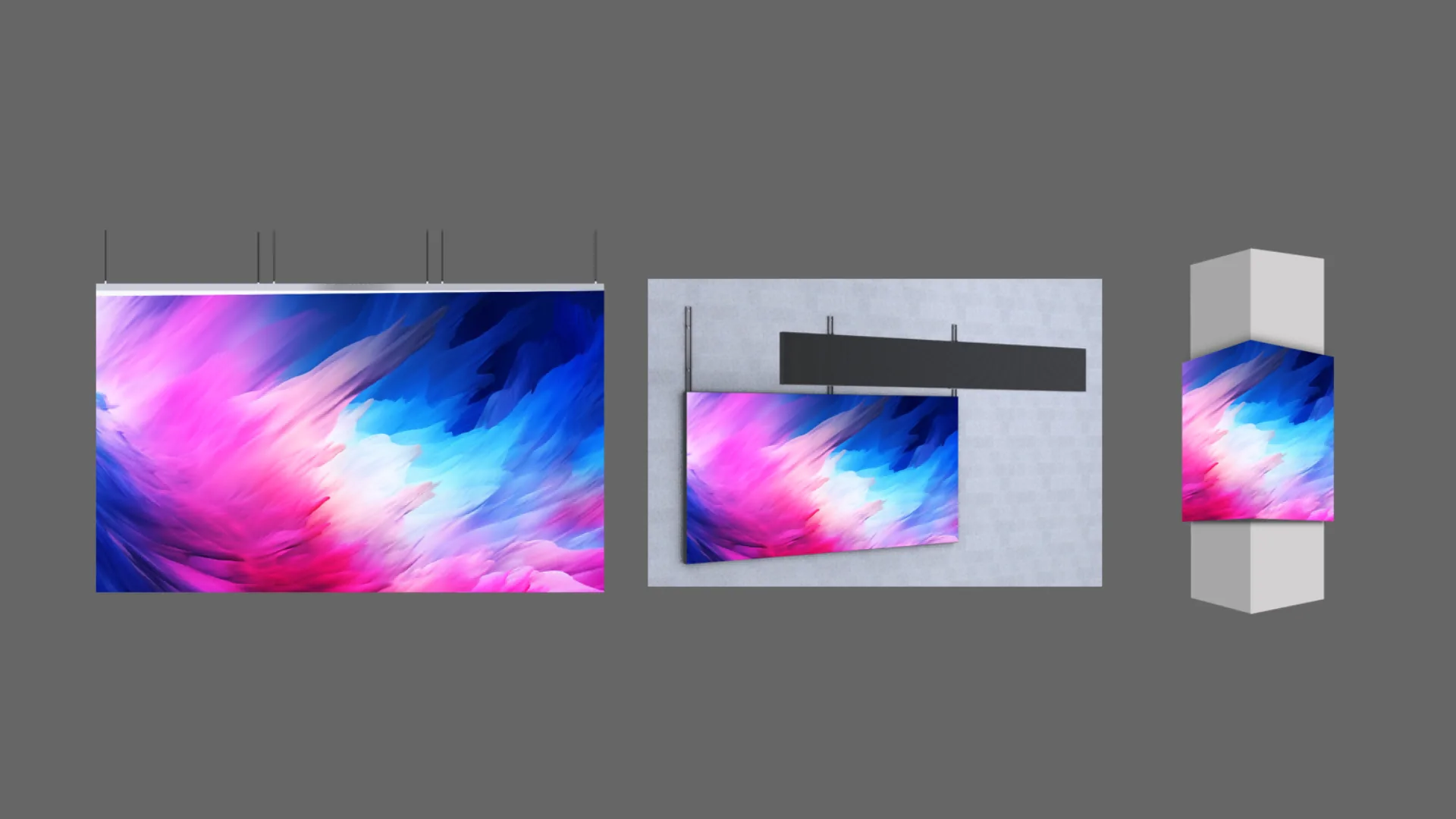
A 16 m² wall with cabinets and mounting steel lands at roughly 300–500 kg. Steel-stud partitions often need reinforcement; masonry usually does not, but the anchor type changes. A structural engineer sign-off runs $500–1,500 and is the cheapest insurance in the whole project.
Front service or rear service
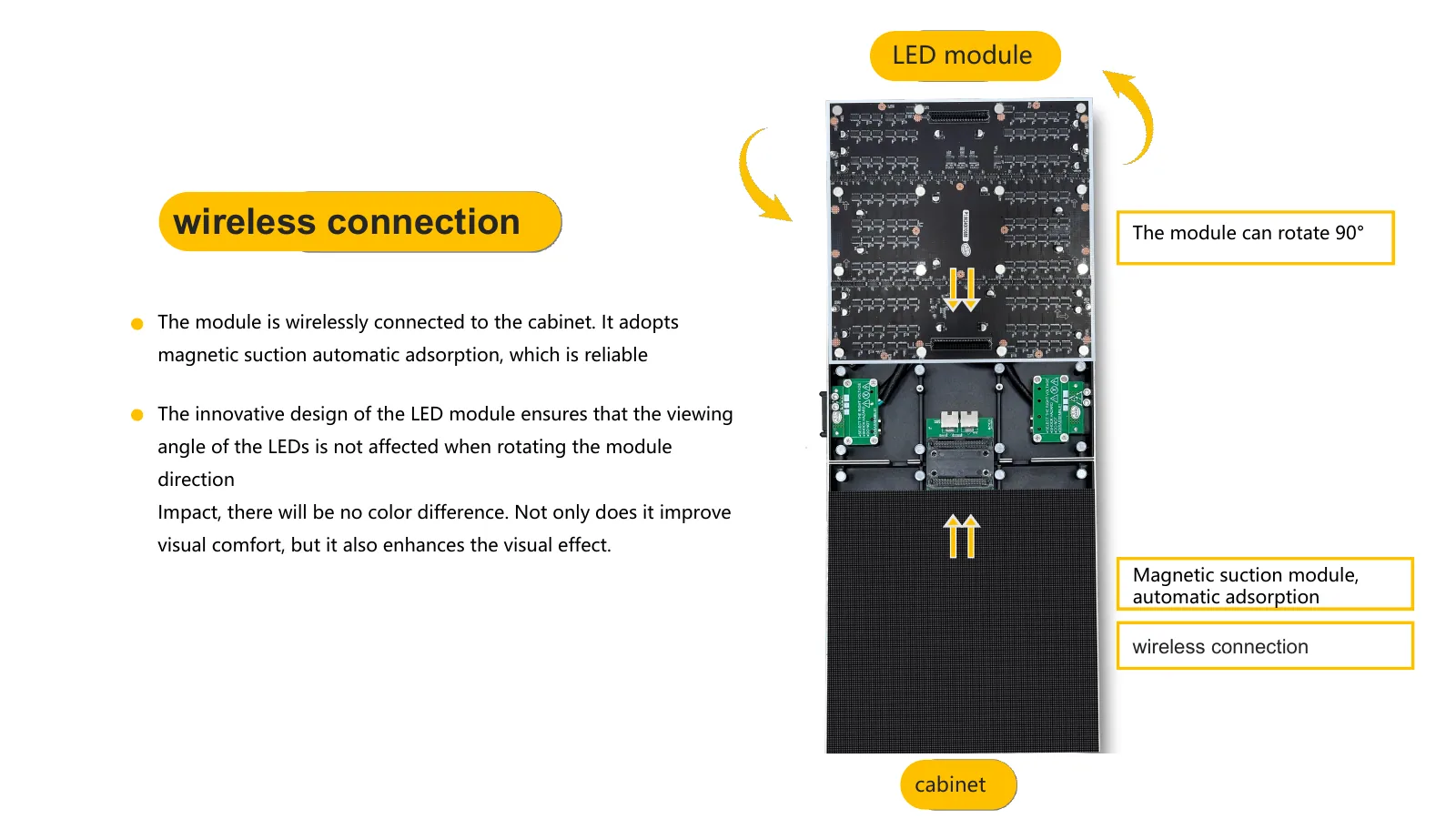
If the wall sits flush on masonry with no rear access, you need magnetic front-service modules — otherwise every dead module becomes a partial dismantling job. Specify this before quoting, not after: it changes the cabinet model and the price.
Power capacity
A 16 m² wall draws 3–8 kW at full white — less in practice, because you will run at low brightness, but the circuit still has to carry the peak. Most sanctuaries need at least one dedicated 20A or 30A circuit added, at $500–2,000 if the panel has spare ways.
Cable routes and access
Cat6 to the processor, mains to the cabinet, and a signal path from the booth that does not run parallel to dimmer feeds. In older buildings the hardest part is often the route, not the equipment — a 40 m cable run through a ceiling void can add a day of labour.
What a church LED screen costs, and where the money goes
Panel-only church LED screen pricing for indoor walls, FOB Shenzhen, 2026 export ranges. These are the numbers we quote, not distributor list prices — and they are why a factory-direct wall lands at roughly half a turnkey integrator quote for the same room.
| Screen size | Area | P2.5 panels | P3 panels | P4 panels |
|---|---|---|---|---|
| 8 × 4.5 ft (2.4×1.4 m) | ~3.4 m² | $2,400–3,600 | $1,700–2,600 | $1,300–2,000 |
| 10 × 5.6 ft (3×1.7 m) | ~5.2 m² | $3,600–5,400 | $2,600–3,900 | $2,000–3,000 |
| 13 × 7.4 ft (4×2.25 m) | ~9 m² | $6,200–9,300 | $4,400–6,700 | $3,400–5,100 |
| 17.5 × 10 ft (5.3×3 m) | ~16 m² | $11,000–16,500 | $7,800–11,700 | $6,000–9,000 |
| 23 × 13 ft (7×4 m) | ~28 m² | $19,000–28,500 | $13,500–20,300 | $10,400–15,600 |
Add $600–2,500 for a video processor, $200–500 for receiving cards and cabling, and $800–3,000 for a wall-mount or ground-support structure. A complete 16 m² P2.5 system, shipped and installed with volunteer labour, lands around $19,000–27,000; the same wall through a US integrator typically quotes $35,000–55,000.
The full line-by-line breakdown — freight, customs, electrical, structural review, spare modules and the content budget nobody mentions — is in our church LED screen cost guide. Read it before you compare quotes; the two most common ways churches overspend are buying a pitch they cannot see the benefit of, and forgetting the $3,000 that sits around the panel.
From drawing to first service
A church LED screen wall is a fixed deadline project — it has to be running by a specific Sunday, and there is no second attempt in front of the congregation. This is the sequence we run, and the points where churches lose time.
Room survey
Dimensions, balcony position, wall construction, power available, cable route and camera positions. Photos and a rough sketch are enough to start.
Layout and quote
Cabinet count at the size that fits the wall, pitch recommendation with the reasoning shown, and an itemised quote including spares and freight.
Production and test
15–25 working days for a standard indoor wall. Every cabinet is aged and photographed before packing; you receive the test video, not just a packing list.
Install and handover
Remote commissioning support, a labelled input map and a written boot sequence your volunteers can follow. Two-year warranty on cabinets, driver boards and modules.
All panels ship with CE and RoHS documentation, and we can supply ETL-listed power supplies where the local inspector requires them. Spare modules are quoted at roughly 2% of panel count — the industry standard, and the reason a dead module is a ten-minute fix rather than a four-week wait. For a portable or touring setup rather than a fixed wall, the Lyra portable rental LED screen uses the same modules on a flight-cased cabinet.
Worship display questions we answer every week
How big should a church LED screen be?
Height is usually set at 8–10% of room depth: a 70 ft (21 m) sanctuary points to a 6–7 ft (1.8–2.1 m) tall wall. Width follows the content ratio and the stage opening — most walls land between 13 and 23 ft. Size it from the balcony sightline, not from the floor, or the top of the screen disappears for anyone under the overhang.
What pixel pitch do we need?
P2.5 if the nearest viewer is under 6 m, P3 for 6–9 m, P4 for 9–14 m. Use the balcony distance when it is shorter than the floor distance. Anything finer than the room needs is money you could spend on the processor and spares instead.
How bright should it be for livestream?
800–1,500 nits with low-brightness high-grey-scale and at least 3,840 Hz refresh. High-brightness panels are the main cause of blown-out screens on camera feeds. Ask for dimmed footage from the factory before you commit.
Can it be mounted on an existing wall?
Almost always, but the wall decides the method. A 16 m² wall weighs 300–500 kg with structure, so steel-stud partitions may need reinforcement. If there is no rear access, specify magnetic front-service modules — it changes the cabinet model and must be decided before quoting.
How much does a church LED screen cost?
A church LED screen runs roughly $60–95 per square foot for indoor P2.5 panels, factory-direct, in 2026. A typical 16 m² wall runs $11,000–16,500 in panels, around $19,000–27,000 complete with processor, structure, freight and installation. Turnkey integrator quotes for the same wall usually land at $35,000–55,000.
What is the lead time?
15–25 working days for production on a standard indoor wall, plus 25–35 days ocean freight to the US. If you have a fixed dedication date, work backwards from the installation week, not the order date — the two most common delays are the electrical circuit and the structural review, both of which are local.
Do we need a full-time AV technician?
No, and you should not buy a system that does. What you need is presets for your three or four recurring content states, a labelled input map, and a one-page boot sequence taped inside the booth door. We write that document for every church install.
Get a worship screen quote
Send room dimensions, balcony position, wall construction and whether you livestream. You will get back a cabinet layout, a pitch recommendation with the reasoning shown, and an itemised price — not a per-square-metre number with the extras hidden behind it.
JDX TECH · LED display manufacturer, Shenzhen, China · Factory and certification details